The Lives of Carruthers
Read the previous chapters:
VII. Meet ‘Eric Ambrose’
‘After Ambler things were never the same again. Instead of being about the sporting wagers of gentlemen, thrillers became realistic, set in the gutters and alleyways of Eastern Europe.’ Frederick Forsyth
*
Michael Barber: ‘I think you said that there is a criminal and a policeman in every human being. Do you think this is where the appeal of the spy story or the detective story lies – this is why people keep reading them?’
Eric Ambler: ‘Yes, I dare say it is. Criminal and policeman – there’s also an anarchist. And I think in the thriller, the anarchist is having a field day.’¹
I’ve felt a little like an Eric Ambler character lately, immersed in a feverish quest to filter the truth through layers of discrepancies, omissions and myths.
One obstacle has been that a lot of the available information about Ambler stems from Ambler himself – and he, like some of his characters, was sometimes an unreliable narrator. This is a man who titled his autobiography ‘Here Lies’. Most have taken this as a laconic joke acknowledging the tendency we all have to embellish details of our own lives, but perhaps it’s better viewed as a mischievous statement of intent. In the opening chapter, Ambler describes vividly and at length an accident he had in Switzerland as a result of being gassed by fumes from his car, after which he was taken to hospital, X-rayed, and then told by a neurologist that he might be suffering brain damage from concussion. At two separate points in the account, Ambler provides information that dates the incident unequivocally to the early 1980s: he tells us his birthdate on his driving licence makes him ‘seventy-two, pushing seventy-three’, and that he had lived in Switzerland for ‘fourteen or fifteen years’ at the time. However, the whole incident, and many of its details, are remarkably similar to a scene in Ambler’s novel The Intercom Conspiracy, in which the protagonist has a car accident in Switzerland after being sprayed with nerve gas, is taken to hospital, X-rayed, and then told by a neurologist that he might be suffering brain damage from concussion. And that novel was published in 1969.
One plausible explanation for this is that Ambler had a minor car accident when he moved to Switzerland in 1968, dramatized it in a thriller shortly after, and then for some reason deliberately placed false indications about when it happened in his autobiography many years later.
It’s plausible, but impossible to know for sure. And as the incident takes up much of the first chapter of Here Lies, which is only 12 chapters long, how much can we trust of what Ambler wrote about his life in the rest of the book and elsewhere? There are a few other instances that I don’t think can be explained as unintentional errors.
Perhaps this isn’t all that surprising. One of Ambler’s strengths as a writer was to make the events he described seem completely plausible, and I think this transferred to his statements about himself. Critics and journalists have almost without exception taken at face value his version of himself. Nearly all Ambler’s profiles and interviews describe him as some variation of quiet, reserved and conventional: ‘impeccably courteous’ and ‘ultra-English’²; ‘somewhere between an Oxford don and a successful banker’ and ‘the picture of a model English gentleman’.³
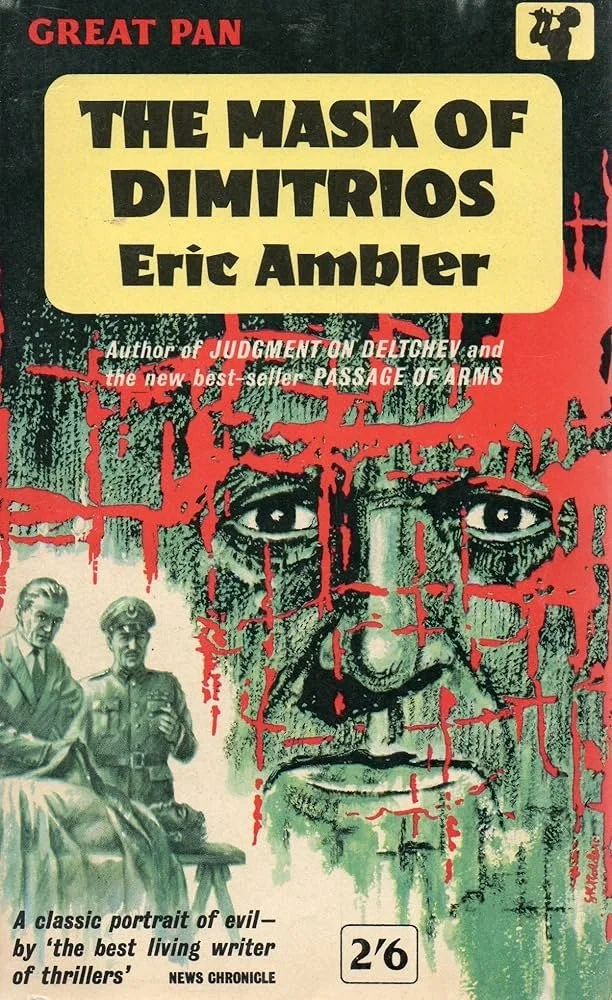
These descriptions call to mind Ambler’s of his villains, particularly Dimitrios in The Mask of Dimtrios, who is at one point called ‘a picture of distinguished respectability’. But unlike with his villains, first impressions of Ambler usually held. That, I suspect, was his intention. Ambler was an advertising copywriter before he was a published novelist, and his presentation of his public persona was, I think, very carefully curated. So much so that on digging deeper into his memoirs I even started to wonder whether Ambler was telling the truth at all, or if he might have taken on an elaborate assumed identity. This led me to research some of his statements about his life in newspaper archives – the fundamentals all checked out, but in the process I came across several short stories he wrote under a pseudonym before the publication of his first novel.
I will look at them in detail, but first – as befits someone untangling the complicated threads of an enigmatic figure – let me present you with a dossier I’ve prepared about Ambler, which I hope is both illuminating and will provide useful context for those stories.
DOSSIER ON ERIC AMBLER
Name: Eric Clifford Ambler
Place of birth: Charlton, London
Date of birth: 28 June1909
Professions: Engineer (trainee), advertising copywriter, inventor of the modern suspense thriller
The subject was a troubled boy with criminal tendencies. ‘I’ve written about irrational fear,’ he once remarked. ‘Mainly because I have a lot of it myself. Even as a child I was a conspirator who was chased by other conspirators.’⁴
Ambler was from a modest background in London. He was an exceptionally clever boy – a polymath of sorts – but was bored by homework and hated his schooldays:
‘I loathed it. I loathed it for years. I hated all the masters. I was a kind of juvenile delinquent. Today I should be considered in need of care and protection.’⁵
He ‘got used to being beaten’ by teachers at school and became ‘the bad lad of Lewisham Hill’:⁶
‘For friendly masters simple lies were enough. For the others I planned more carefully. They were most vulnerable at exam times when professional pride made them look for success from their teaching efforts. That was the time to strike. The tactic was surprise, the weapon was disappointment. If you could succeed, fail. Top one term, bottom the next in the same subject: that was the way I chose to fight, and a very tiring way it was. I came to see punishment as useful. It strengthened resolve and nourished the hate an enemy of society needs when he is fighting a war.’⁷
One escape from this ‘war’ was reading. He discovered Arthur Conan Doyle at the age of 12 and soon devoured all the Sherlock Holmes stories. He didn’t just read the stories, though: he researched them, tracing the sources of Holmes’ aphorisms in German and French in the public library, in the process both expanding his wider knowledge and learning how to use books for reference.⁸
Another escape, despite his admiration for the great detective, was committing crimes:
‘With my friends, I used to break into private property. I used to have a catapult and break windows. I did everything that boys should be taken and beaten for, if caught.’⁹
And in another interview, he said this:
‘I was a juvenile delinquent. I used to steal cars and such.’¹⁰
We have been unable to identify any records of car theft or breaking and entering, but both these confessions are worth careful consideration. The subject had the uncanny ability of making astonishing statements about himself in such an understated manner that nobody believed him. A useful gift to have.
As an adolescent, Ambler ran scams. One was to sell matchboxes for charity, keeping more than the allotted share of the money for himself. Another took more effort: he placed advertisements in newspapers for horoscopes as ‘Madame Astra’, and would then post the same essay to all who paid to receive a response:
“Those born under your sign,” it said, “have only one thing to fear. That thing is diffidence. You underestimate your abilities and fail to see and cultivate your hidden gifts.”’¹¹
This may be the first time he learned he could make money from writing.
The teenage Ambler was not just an Artful Dodger, but a student of criminality. He was particularly fascinated by the minds of killers, a lifelong interest that ‘originated in a disturbing emotional experience’.¹² This related to a grisly murder trial in East Sussex in which the killer had dismembered the body of his victim in a small cottage located in some sand dunes:
‘From the point of view of the serious murder-fancier it was not a particularly distinguished crime. There was no mystery about it, and, in spite of the newspapers’ efforts, precious little of the macabre […] However, distinguished or not, it was the first real murder case in which I had taken an interest. A lad of fifteen, I had just read Dostoevski’s Crime and Punishment and been shattered by it. Wrapped in the mantle of Raskolnikov, I used to go for long, gloomy walks in the more depressing quarters of London, looking for fallen women whom I could salute, though from a respectable distance, in the name of suffering humanity.’¹³
The Ambler family went on holiday that year to a resort near the crime scene and, three days before the murderer was hanged, Eric bicycled to the cottage in the dunes:
‘Through solitary communion with the scene of the crime, I felt that I might come to closer grips with the problems of good and evil with which my anxiety-laden mind was preoccupied.
Judge, then, my horror, my disgust, my indignation, when I found the whole site cluttered with morbid sight-seers, and the murder cottage itself practically torn to pieces by souvenir-hunting vandals!
The incident made an unforgettable impression on me.’
This is laced with irony, of course – he was a morbid sight-seer himself, even if he regarded himself as other than that – but it predicts a key theme he would explore in his fiction: coming to close grips with problems of good and evil.
Ambler’s first close friend was a boy in the same form at school, George Sims. Sims was delicate, ‘pale, frail and walked with a slight stoop’, and generally ignored by other schoolmates, but he was highly intelligent and had a ‘taste for crime and melodrama’ as keen as Ambler’s:
‘His heroes were the great scientific detectives: Sherlock Holmes and Dr Thorndyke, of course, but also the less well-known Professor S.F.X. Van Dusen, the astonishing and all-powerful Thinking Machine created by Jacques Futrelle.’¹⁴
Sims’ father was a mechanical engineer, and the two boys conducted elaborate chemistry experiments in a spare room in the Sims’ house, converted into an engineering workshop, as well as a makeshift laboratory in the kitchen.
In 1925, aged 16, Ambler took a scholarship exam for a BSc degree course in engineering at what is now City University in London. One of nearly 200 to take the exam, he won the top scholarship, being awarded 100 percent for his chemistry paper and 95 percent in physics. This was significant, as it meant his tuition was paid in full: his father’s condition for him being able to attend.
However, Ambler soon became bored of his university course and started playing truant. He divided his days between watching plays on the West End, following trials in court from the public gallery, and reading, either genre fiction or academic material in the library of the Institute of Electrical Engineers:
‘For a time I spent my mornings there with Steinmetz’s Theory and Calculation of Alternating Current Phenomena or reading the latest scientific journals.’¹⁵
Music was nearly as important as science and literature. Before and during the First World War, Ambler’s parents, Reg and Amy, had been in a musical revue act, going under the names Reg and Amy Ambrose. Following the General Strike in 1926, Eric left university and briefly tried to emulate them in a double act with his uncle-in-law, Bob Barclay. Calling themselves ‘Barclay and Ambrose’, they performed at working’s men’s clubs, with Barclay singing and Ambler accompanying him on piano, including on some original songs he had written.
This soon dissolved, but Ambler was writing furiously, finishing four plays and two novels before he was 19 – all unpublished.¹⁶ He was scathing about some of these early plays in later life. One, White to Harvest, had ‘nothing at all to commend it except a plot; and that was probably stolen from another source’. He also wrote a one-act play for the British Drama League, Just Until The Rain Stops, which was put on a few times¹⁷:
‘I can remember the idea because that was stolen from an Austrian novelist, Leo Perutz. A man escapes from police custody and spends a day and a night trying to free himself from the handcuffs he is wearing. Perutz wrote it as a thriller of the kind that German film makers of the period used to like, with plenty of inexpensive location footage punctuated by character ‘cameo’ scenes. I made a forty-minute play of it. The setting was a tea shop.’¹⁸
The Perutz novel was Zwischen neun und neun, published in German in 1918 and translated into English as From Nine to Nine in 1926. Perutz was a Jewish mathematician and writer born in Prague whose works were banned by the Nazis. His admirers included Graham Greene and Ian Fleming; the latter sent him a letter extravagantly praising his 1928 novel Wohin rollst du, Äpfelchen (published in English as Little Apple).¹⁹
By 20 Ambler was an advertising copywriter, and was soon regularly travelling abroad, mostly to France. The bad lad of Lewisham Hill had become a polished young man, a successful member of the corporate class – at least outwardly. Inwardly, radical ideas were kindling, spurred by both his reading and his travels. In Rome, he had seen Blackshirts armed with carbines at an exhibition of fascist propaganda:
‘The central exhibit was a “shrine” commemorating the fallen heroes and martyrs of the movement, a political lying-in-state […] Though I found it absurd I did not find it amusing. The martyrs, I noted, were all former deputies of the Italian parliament and were shown as they were shot or stabbed in the back by Communist assassins.’²⁰
It seemed to him that the Fascists were trying to erase memories of their kidnapping and murder of socialist politician Giacomo Matteoti in 1924.²¹ Ambler sometimes downplayed his youthful political leanings, telling the New York Times in 1981 that he had been ‘a little to the left’.²² However, when asked by Michael Barber whether he had been ‘pretty left-wing’ in the 1930s, he was unequivocal in his reply:
‘Oh, yes. Far left. Couldn’t have been farther, I would think.’²³
And to Clive James, he said:
‘I was ready for the barricades. Anything anti-Fascist, I was on its side. I was a very far Left socialist.’²⁴
In 1976, Gavin Lambert published a ‘biographical investigation’ of nine writers. Here is his depiction of Eric Ambler in the early 1930s:
‘The young Englishman often seen at some shabby Paris bar in the early hours of the morning looks neat and quiet, almost dapper. People comment on his resemblance to the Duke of Windsor. Sometimes he sits and drinks alone. On these occasions he is probably turning over a new discovery, this time about himself. It started with “guilt feelings”, murderous private fantasies intense enough to make him wonder whether he might be personally capable of murder. He notes how often people say “I wish he were dead” and mean it. The impulse to kill has grown alarmingly common. It seems to come from the surrounding air.’²⁵
In London, one of Ambler’s advertising colleagues was a published writer, and suggested that he write short stories. Ambler got hold of as many copies of ‘the popular-story magazines and pulp periodicals’ as he could, and studied them – many were serials published by the Amalgamated Press:
‘I did not enjoy wading through this rubbish and I should have abandoned the idea of trying to reproduce it. The skills of a good copywriter were his abilities to say much in little and to say it lucidly; to say it with wit or in a particular style was not necessarily useful. In any case, such skills are not always transferable. But I was caught by the challenge.’²⁶
He wrote ‘three stories in what I believed to be the manner of the Home Companion romance’, and his colleague sent them to his literary agent. But when Ambler went to her office, she gave him a dressing down:
‘“You make a mistake you clever young men. You think you can write down to the market. You think it’s easy to write trash. You’re wrong. It’s easy to write imitation trash. It’s quite difficult to write the real thing. For that you have to have a knack and, I’m afraid, a certain talent. On the evidence of these stories all you have is the trick of parody.”’²⁷
The clever young man retreated with his tail between his legs.
Ambler related all this in his 1993 book The Story So Far, in which he interspersed autobiographical material with several previously published short stories. The book was subtitled ‘Memories and Other Fictions’.
At some point in the early 1930s, Ambler found himself in a hotel room in Marseilles, lining up the entrance to a bar opposite in an imaginary telescopic sight. In October 1934, he was stunned to see newsreel footage of the King of Yugoslavia being assassinated at the same street crossing in Marseilles, stirring his imagination: ‘I felt I had a fresh character: a fresh bit of me was an assassin, who could plan and execute these things.’²⁸
In 1935, he started work on The Dark Frontier, which would become his first published novel, and within a few years he had reinvented the thriller.
So there is a potted biography of the early Eric Ambler. Let me highlight three points. Ambler told us the following about himself:
He wrote constantly before he was a published novelist: several plays and novels, but also at least three ‘trashy’ stories that he didn’t sell.
He used the alias ‘Eric Ambrose’ for at least one creative endeavour: the musical double act.
A real assassination in France coincidentally resembling an experience of his own was a major spark in him turning to the thriller genre.
What if Ambler omitted or distorted a few elements from his accounts?
What if the origin story in Marseilles was just that: a story?
And what if he wrote short stories for the commercial market that were in fact published – under the name Eric Ambrose?
Between 1932 and 1936, 16 short stories appeared credited to ‘Eric Ambrose’, most of them in London newspapers. I am sure they were all written by Eric Ambler. They are well-crafted and entertaining, and five of them are excellent. One is in much the same vein as his best-known work, and also changes the accepted version of how Ambler developed as a writer.
But hang on, you might say. Sixteen stories? If that’s true, how is it not already known? You might also be wondering how, if they were published under a different name, I can be certain they were written by Ambler.
I think this has gone under the radar for a few reasons. Firstly, Ambler never mentioned writing these, and as above I suspect he went out of his way to conceal that he did. Most of the stories appeared in the Evening Standard and the Evening News, newspapers with very wide circulations, and a few have been republished in anthologies over the years, but as Ambler dropped this pseudonym once The Dark Frontier was published under his own name, they have simply remained ephemera, gathering dust. Both those newspapers published a short story every day for years, and their archives contain stories by dozens of writers nobody has ever heard of today; no doubt a few of those will also have been temporary pseudonyms for not-yet-famous authors developing their craft for a bit of cash.
I think another reason this has gone undetected is due to one of those odd coincidences that sometimes plague research. It so happens that there was a British architect called Eric Ambrose, who was born in 1908, the year before Ambler. A partner in the practice Nightingale and Ambrose, he is perhaps best known for his work on the racing driver Stirling Moss’s Mayfair flat in the 1960s.²⁹ For several years, this architect wrote a monthly column for Ideal Home magazine, which he turned into a book called Know Your House in 1954. He also published five short stories in the 1950s, most of them in The Evening News.³⁰ I think, for understandable reasons, Ambler’s stories as ‘Eric Ambrose’ from the 1930s have been mistakenly attributed to the architect of the same name.
The obvious response to this is that surely all the stories are by the architect. What are the chances of there being two writers of short stories with the same name in the same newspaper? However, I think it’s very clear that the 1930s and 1950s stories are by different authors. The 1950s stories are clearly by the architect for a few reasons. One of the stories, ‘The Altruist’, is about a man disposing of a bomb on a cargo ship following the end of the Second World War – the architect had been a bomb disposal expert in the war. In addition, the 1950s ‘Ambrose’ stories have totally different themes and styles to those from the 1930s. Apart from ‘The Altruist’, they are barely stories at all, in fact, more like whimsical vignettes, and – apologies to the architect’s heirs if they’re reading – they’re just not good. Here’s how one opens:
‘My uncle, Marcus Aurelius Pepperpot, is a very unusual barrister. He says so himself, and he stresses the fact on many occasions when telling me of his success in great detail.
Last week we were discussing the failure of the police to solve a local robbery. “It’s not easy these days,” said my uncle.’³¹
It seems extremely unlikely this could have been written by Eric Ambler, 15 years into a career as a bestselling-novelist and successful screenwriter. One only has to open Judgement on Deltchev, published a year before this, to see the difference. The prose in the 1950s stories is markedly more amateurish than even the weakest of the 1930s stories.
So this would entail an odd coincidence: a pre-fame Eric Ambler used the pseudonym ‘Eric Ambrose’ to publish short stories in newspapers in the 1930s, and then around 20 years later an architect who happened to be called Eric Ambrose also wrote and published short stories, including in one of the same newspapers. It’s odd, certainly, but the alternative – that the architect wrote them all – would entail many more coincidences, and of a much greater magnitude.
So let me give some detail about these 1930s stories. I’ll list them in chronological order of publication, but they were probably not written in that order. Some of the stories published earlier are rather better written than ones published later, and suggest a more mature writer. Ambler might have submitted stories years after he wrote them, or in batches, or both. Newspapers would not have felt any need to publish them in the order he sent them, and there would likely have been delays due to a backlog in submissions. To give one example of this, the first publication of Carlton’s Father I’ve found is the Evening Standard in March 1936, but it was republished in Western Australian newspaper The Daily News in July 1938, by which time Eric Ambler was a well-established novelist.
These stories are, in the main, far from the polished thrillers Ambler would become famous for a few years later. Neither are they comic, like the songs and verse he was writing around the time, or neo-Expressionist German, like his plays. They were commercial fiction written for daily newspapers with a huge circulation. They nevertheless have a few Ambler hallmarks that make it clear he wrote them. They range over genres and styles, but certain themes reoccur. These are Eric Ambler experimenting, on a journey to find his voice. I’ll go through them in detail, but first here’s the list:
Beyond the Wall
Published in the Evening Standard, 2 November 1932, starting on page 22
The Fear of Fear
Published in the Jewish Forum, March 1933 issue, p29
The Dutch Defence
Published in the Evening Standard, 3 May 1933, p26
The Man Who Was Tomorrow
Published in the Evening Standard, 19 September 1933, p22
Undercut
Published in the Evening News, 24 October 1933, p11
Heavy Water
Published in the Evening News, 18 January 1934, p14
The Man Who Died
Published in the Evening Standard, 3 May 1934, p26
Forward Pass
Published in the Evening News, 22 May 1934, p4
Sinister Skull
Published in the Evening News, 6 September 1934, p4
The Man Who Disliked Death
Published in the Evening News, 11 March 1935, p14
Chinese Crackers
Published in the Evening News, 9 December 1936, p12
The Man Who Saw Within
Published in the Evening Standard, 20 April 1934
The Sin of Malach Hamoves
Published in the Jewish Chronicle Supplement, Issue 3394, 27 April 1934, piii
The Devil Machine
Published in Maclean’s Magazine, 15 June 1935, p17
Carlton’s Father
Published in the Evening Standard, 5 March 1936, p26
Queen Bees
Published in the Evening Standard, 27 October 1936, p22
I accessed these online: all but three via the British Newspaper Archive and Newspapers.com. I found one at Archive.org (The Sin of Malach Hamoves) and one at Google Books (The Devil Machine). One I had scanned and sent to me by the New York Public Library.
I’ll start with that one, which I think is the most unmistakably by Ambler, and the one in which he found the voice he was looking for.
The Fear of Fear was published in March 1933 in The Jewish Forum, a modern Orthodox Jewish monthly magazine published in New York³². That’s a surprising place to find a story by Eric Ambler, and to make my case seem (I hope only momentarily) weaker, Ambler was not Jewish, while the architect Eric Ambrose was. To make it weaker still, this story was credited to ‘Eric S. Ambrose’. Ambler’s middle name was Clifford, and the architect’s middle name was Samuel.
But bear with me a little longer, and I think you’ll agree there can be no doubt that Ambler wrote this.
The first indication is the title. The Fear of Fear brings to mind Journey into Fear, of course, published seven years later, but it also has a similar mood and cadence to Cause for Alarm, The Mask of Dimitrios, The Light of Day, and The Care of Time.
A much larger indication is the type of story this is. None of the other ‘Eric Ambrose’ stories could really be called thrillers. Most are set entirely in England and are either in the ‘uncanny’ and supernatural vein of Edgar Allen Poe and M.R. James; science fiction, featuring time travel and reincarnation; or similar to parables. Several feature murders, but none are in the genre that Ambler would become famous for inventing in the late 1930s: tense, realistically drawn thrillers that explored the dark political complexities of the time. The Fear of Fear is precisely in the same vein as Ambler’s novels, featuring a theme that dominated them (assassination), set in a city he knew (Paris), with prose that reads like his. For someone else with a near-identical name to have coincidentally written such a story in 1933 already seems to me to be extremely unlikely.
But on top of this, the story contains one short scene that I think establishes beyond any doubt it was written by Eric Ambler.
The story opens like this:
‘In the year 1929, a young Jewish student shot a General in a squalid street in Paris.’
It’s just a single sentence, but right from the start this reads like Ambler: it’s matter-of-fact, authoritative, and instantly compelling. The use of a date to ground it was also something Ambler was fond of doing, as in the opening of The Schirmer Inheritance (1953):
‘In 1806 Napoleon set out to chastise the King of Prussia.’
And The Intercom Conspiracy (1969):
‘It was on May 31 of last year, at Geneva’s Cointrin airport, that the man who called himself Charles Latimer disappeared.’
The rest of the story is written in a similar, and familiar style; as John le Carré once noted, Ambler’s prose had a ‘marvellous plainness and lucidity’.³³ The sense is that we are not reading fiction, but documentary reportage on real events. Decades later, this technique would be favoured by Frederick Forsyth and many other thriller-writers. It was not at all the norm for thrillers in 1933.
So from the first sentence we know it’s about an assassination in a squalid street – let’s return to that comment by Forsyth:
‘After Ambler things were never the same again. Instead of being about the sporting wagers of gentlemen, thrillers became realistic, set in the gutters and alleyways of Eastern Europe.’³⁴
We’re in Paris rather than eastern Europe, but here we are three years before his first novel was published, down in the gutters and alleyways. Eastern Europe also features heavily in the story, both in plot and atmosphere. The first lines are in italics because they’re part of a framing introduction, something Ambler did in many of his novels, setting up stories within stories with a preamble. Here, he opens by discussing an assassination that took place in Paris in May 1926, that of Ukrainian general Symon Petluria by Sholem Schwarzbard. Schwarzbard acted out of vengeance, holding Petluria responsible for the pogroms in Kishinev and elsewhere that had killed thousands of Jews, including several members of Schwarzbard’s own family. He approached Petluria in a street in Paris and shot him dead, and despite proudly confessing to the deed was sensationally acquitted in a much-publicised trial after his defence effectively argued that justice had been carried out.
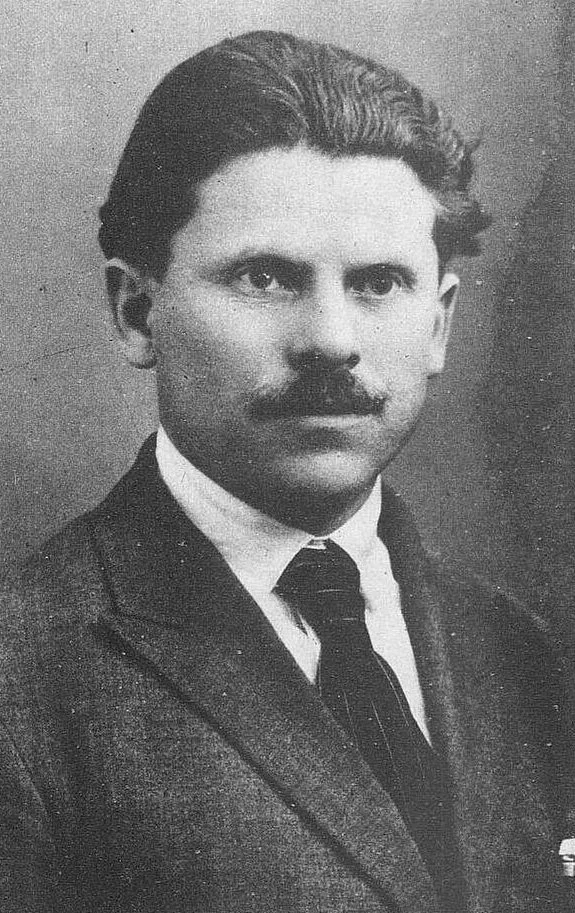
Sholem Schwarzbard (Source: Wikipedia)
The Fear of Fear is inspired by the assassination of Symon Petluria, following a fictional but very similar event set three years later. It seems likely that Ambler already knew about the Pelturia assassination, as the trial was a major event and he had long been fascinated with crime stories like it, but the story is also carefully researched. There is a long quote from Max Margolis and Alexander Marx’s 1927 book A History of the Jewish People to establish the horrific context of the pogroms, and various references to the trial and Paris that are inserted authoritatively, as though the reader would naturally know all this, too. That’s a very Ambler trait.
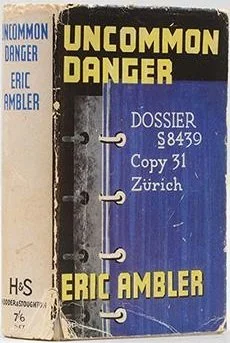
Sholem Schwarzbard himself had several aspects to him that would crop up in later Ambler works. He was born in Bessarabia, of which Kishinev was the capital. Located in what is now Moldova and Ukraine, but at various times part of Russia, Romania, and the Soviet Union, Bessarabia received a name-check in The Dark Frontier (Conway Carruthers learned one of his survival tricks from a ‘Bessarabian moujik’). It also featured heavily in Ambler’s second novel Uncommon Danger (1937), in which the plot hinges on Russian plans for an attack on Bessarabia because of its oil fields. Could it be that reading about the Schwarzbard case and the Kishinev pogroms is where Ambler first learned of Bessarabia?
Schwarzbard was a Communist Jewish assassin who had fought with an anarchist unit in Ukraine and written for Yiddish anarchist publications in London. At this time, Ambler was fascinated by all these attributes. He was ‘ready for the barricades’. As I discussed in my previous post, assassinations are a major feature of several of his novels, while his final one, The Care of Time, involves the supposed memoirs of the 19th-century Russian communist revolutionary nihilist Sergei Nechaev. Finally, a motive for Ambler writing thrillers was his desire to overthrow the anti-semitism that plagued the genre:
‘It was a pretty shoddy article. The characters in the Bulldog Drummond books were really wooden – ghastly. Sapper’s heroes got their kicks out of kidnapping and flogging Jews and Communists.’³⁵
So for Ambler to have written a story in the early 1930s inspired by an avenging Communist Jewish assassin makes sense. But once he had written it, where would he be able to publish it? The Evening Standard and the Evening News would probably have been a stretch, both because this is a longer story than newspapers usually published and due to its subject matter: we are asked to empathise with an assassin. Submitting it to a Jewish magazine, many readers of which would be very familiar with the Schwarzbard case and likely sympathetic to the motives behind it, also makes sense.
How about the setting? We know Paris was a city Ambler visited several times in the 1930s, at a time when few Brits could afford to (the story has ‘Eric S. Ambrose, London’ under the title). It’s an unusual topic and perspective for an English writer in his early twenties, as Ambler was when this was published. Perhaps, though, not such a stretch for someone who had become obsessed with Crime and Punishment at 15 – or for someone who had imagined killing a barman with a sniper rifle from his hotel window while on holiday in Marseilles. Like a prototypical Walter Mitty – or a Professor Barstow believing himself to be the brilliantly competent secret agent Conway Carruthers – The Fear of Fear sees Ambler imagining himself into the head of an assassin.
The assassin in the story is named Hayim Nahum. A Jew, he is determined to kill a Russian general, Krushnikoff, who he has learned is in Paris and who he holds responsible for pogroms in Kishinev. Our introduction to Nahum brings to mind Gavin Lambert’s description of Ambler contemplating murderous private fantasies in a Paris bar:
‘Hayim Nahum was sitting in a café of the Quartier Latin. He forgot his coffee. He just stared, with eyes which no longer saw, at the newspaper which he still held loosely in his hands. It was only one line which had caught his eye, a seemingly insignificant line under “Recent Arrivals”, but it was sufficient to send his mind back seven years to dwell upon that Easter Sunday in Krishnov:
“M. Krushnikoff and Mme. Krushnikoff have arrived in Paris.”’
We learn that Nahum was born in France and brought up in comfort, but that since childhood he has been filled with a fear ‘so intense that it burned into his soul, a rational insane fear… of fear’.
Nahum becomes obsessed with Krushnikoff’s presence in Paris:
‘Sitting outside the sombre café on that cold October night, when no one else had ventured from within the distempered walls, three words chased themselves across his brain, so that there was no room for other thought: “Krushnikoff is here.”
He decides he must kill General Krushnikoff, but how? In my previous post, I discussed how in The Dark Frontier, Carruthers visits the Latin Quarter of Paris and buys an automatic from a gunsmith there. Notably, the gunsmith is in Boulevard Saint Michel, and in an introduction to the novel written years later Ambler explained at length how this unlikely-seeming street for such a place was in fact accurate. Sholem Schwarzbard shot Symon Petluria dead in the Latin Quarter of Paris, on the corner of Boulevard Saint Michel. However, it’s not known where he got the gun. In The Fear of Fear, Ambler has Nahum visit a café in the Latin Quarter, and then a gunsmith:
‘He hesitated once more before he entered the gunsmith. Did his people call for vengeance? – what would be gained?’
He decides it is worth it as he will be ‘wiping out a useless specimen, a dangerous serpent’:
‘He noticed the gunsmith looking at him curiously. Perhaps he was insane. His head ached – yes, perhaps he was insane – suppose he was; then they must not suspect. He must laugh it off: joke about it. And so he laughed and joked about it, and the man was satisfied. He paid the thirty francs for the instrument, and it seemed to him a lot of money just to kill a rat.’
So this is a story set in the Latin Quarter of Paris, inspired by a real event that took place in the Boulevard Saint Michel, in which the protagonist buys a weapon from a gunsmith in the area, something Eric Ambler later pointed out seemed a very unlikely neighbourhood in which to find one. In The Dark Frontier, published three years later, the protagonist buys a weapon from a gunsmith, and does so in the Boulevard Saint Michel. This seems like, well… a smoking gunsmith.
Nahum conducts surveillance on Krushnikoff from a hotel opposite his, and here too we have a foreshadowing of Ambler’s writing, but this time of his anecdote about Marseilles and him waiting in his hotel room for the barman to cross into his line of fire at the intersection he overlooks:
‘Krushnikoff was to pass by that bend in the Rue Hernani on the morrow at eleven. That was definite. For a week he had watched him leave the hotel every morning at ten or thereabout to return just before noon.’
Nahum then decides he should move hotel:
‘He had been made to pay in advance, because he had brought no luggage, and he felt this was a mistake on his part, for it had attracted attention to himself. And so the following day he moved and, adopting another false name, stayed in a different part of the city. This time he arrived with luggage.’
At the Louvre, Nahum overhears Krushnikoff making plans to visit the Russian Embassy at eleven o’clock the following morning.
‘Nahum dressed carefully that morning, slowly, meticulously. He settled his bill and, retiring to his room, examined the chambers of his revolver. Then he left the hotel for the last time.’
Placing his luggage at the Consigne of the Gare du Nord, he buys a ticket to Abbeville, then starts to worry that he won’t have the marksmanship needed to pull off the deed. He calms himself and has breakfast at a café, and at five to eleven positions himself ‘behind the bend in the narrow street’ where Krushnikoff is due to pass. After some tense build-up, the two men face each other. Krushnikoff’s wife is there, giving Nahum fresh doubts:
‘One could not kill the rat before the eyes of his wife.’
But Krushnikoff returns alone, and Nahum does the deed:
‘Eye witnesses said that the young man pulled a revolver from his pocket, and fired point blank at the poor old gentleman with the kind eyes.’
Unlike Schwarzbard, Nahum doesn’t confess or say anything in his defence. He is found guilty in court, and although the trial is widely reported, not much interest is taken in Russia, ‘since they were tired of Krushnikoff, and not in the mood for another pogrom’. Now partially blind, Nahum is sentenced to death and at the guillotine calls out in an agonised voice. Some say it is gibberish, but the rabbi present claims he called out the Shema: ‘Hear, oh Israel, the Lord our God, the Lord is One.’
It’s an odd story in some ways; not quite fully formed, and yet intense, crisp, with some highly effective moments of suspense. There are echoes of it across Ambler’s novels: the clean, matter-of-fact prose style; real-world eastern European politics; a pervading sense of anxiety; assassination; scenes in Paris alleyways, cafés and hotels; and more. Incidental moments, such as the hotel switch due to the luggage, the Russians being tired of Krushnikoff, the bend in the road, ‘the poor old gentleman with the kind eyes’ – all feel indelibly like Ambler. There is also a striking echo of it in Epitaph for A Spy (1938), in which one character gives a detailed analysis of an assassin’s fears of shooting someone in the street:
‘The number of attempted assassinations of English officials in British India is, not unnaturally, very high. The interesting thing is the very large number of those attempts that fail. Most of them fail not because Indians are specially bad shots, but because at the crucial moment the would-be assassin becomes immobilized by his instinct against violence. I once talked with a Bengali communist about it. He said that the Hindu might go with hate in his heart and a good revolver to kill the local representative of his oppressors. He might escape detection, he might stand out of the crowd unobserved when the time came and his enemy approached and raise the revolver. The official would be at his mercy. Then the Indian would hesitate. He would see not the hated oppressor, but a man. His aim would falter and the next moment he would himself be shot down by the guards. A German or a Frenchman or an Englishman under the same hate-stimulus would have shot and shot straight.’
Not many people were interested in the psychology of assassins with revolvers to this extent, and Hayim Nahum also experiences precisely these instincts in The Fear of Fear: the story’s suspense stems from the inner conflict he has between his desire for vengeance against a ‘hated oppressor’ and his hesitation about whether he can really go through with it.
I don’t think there can be any doubt that The Fear of Fear was written by Eric Ambler – but it does raise a peculiar anomaly. It was published in 1933, but Ambler claimed that it was the assassination of the King of Yugoslavia in Marseilles in 1934 that first turned him towards this sort of story. I think the discrepancy is fairly easily explained. Let’s imagine the following: Ambler didn’t visit Marseilles in the summer of 1934, as he claimed, but instead went on holiday to France sometime in 1932, perhaps visiting Paris and Marseilles in the same trip. He is a keen student of murders and assassinations, and as with the East Sussex dunes he wants to visit the scene of a crime. In Paris, he visits the very neighbourhood in which Schwarzbard killed Petliura. Can he commune with the assassin, put himself in the man’s shoes? While wandering the Boulevard Saint Michel, he is amused to find a gunsmith. Aha! he thinks. That must be where Schwarzbard got the revolver. Then, perhaps a few days or weeks later, he is cheated by a barman in Marseilles. His head filled with assassination plots, he imagines killing the barman from his hotel room. Both events together inspire him to write a short story about an assassination, which he submits to a Jewish magazine in New York and which is published in 1933. A year after that, the King of Yugoslavia is assassinated on the very street corner in Marseilles he had overlooked from his hotel.
If something along those lines happened, the anecdote still fits – it’s just a little over-egged, with the date slightly altered to make a better story. The coincidence was not that Ambler imagined assassinating someone and something similar then took place. It’s that he had already imagined an entire assassination plot, written it down, and had it published. One of his stories had leaked into the real world. And when he saw the news-reel footage from Marseilles, he realised that his short story experiments had found their target. The Fear of Fear was the one that worked, and he returned to follow its path. This story is the missing link between the young writer holding an imaginary sniper rifle and the Eric Ambler who would become famous, and Hayim Nahum and his anxiety-drenched quest for vengeance is the first real Ambler character. Interestingly, the story also leap-frogs the parodic element of The Dark Frontier, and is much more straightforwardly in the literary thriller mould he pioneered.
Ambler never acknowledged writing this or the other 15 stories. This could be for a few reasons: once successful, he shed the skin of ‘Eric Ambrose’ and didn’t want these early efforts rediscovered. They’re not as polished as he had become, but dry runs for the real thing.
Perhaps, too, there’s that ‘S.’ in the pseudonym he used for The Fear of Fear. Did Eric Ambler know about Eric Samuel Ambrose the architect – and perhaps suggest he was him in his cover letter to the Jewish Forum? ‘Dear Sirs, I am the Honorary Secretary of the London Jewish Discussion Group…’ or something along those lines. The creator of ‘Madame Astra’ striking again? Two other stories under the Ambrose name also have a Jewish theme. Perhaps we have an element of an assumed identity after all…
Next part coming soon
NOTES
1. ‘Ambler at 80’, presented by Michael Barber, Radio 4, 30 June 1989. Available in Eric Ambler: A BBC Radio Collection, July 2019 : https://www.penguin.com.au/books/eric-ambler-9781787537095 You can listen to the interview on Spotify and elsewhere.
2. ‘Eric Ambler’ by Malcolm Oran, Publishers Weekly, 9 September 1974, Vol. 206, No,11, p6.
3. ‘An Interview with Eric Ambler’ by Joel Hopkins, The Journal of Popular Culture, Volume IX, Issue 2, 1975. Available at: https://onlinelibrary.wiley.com/doi/abs/10.1111/j.0022-3840.1975.0902_285.x
4. ‘The Mask of Eric Ambler at 80’ by Richard Critchfield, International Herald Tribune, 14 April 1989.
5. ‘“At 19, an agent advised him to forget about writing”’ by Terry Coleman, The Guardian, 2 February 1970.
6. Here Lies.
7. Ibid.
8. Ambler’s Introduction to The Adventures of Sherlock Holmes by Arthur Conan Doyle (Butler & Tanner, 1974).
9. ‘Ambler at 80’.
10. ‘An Interview with Eric Ambler’ by Joel Hopkins.
11. Here Lies.
12. The Ability To Kill by Eric Ambler.
13. Ibid.
14. Ibid.
15. Here Lies.
16. ‘“At 19, an agent advised him to forget about writing”’ by Terry Coleman, The Guardian, 2 February 1970.
17. It was put on at least twice by the Old Wolverton’s Women Institute under this title as late as April and May 1940. See ‘Women’s Institute Help Wolverton Forces Gift Fun’ in the Bucks Standard, 27 April 1940, and ‘Stony Stratford: Concert for Comforts Fund and Red Cross Depot;’ in the Bucks Standard, 11 May 1940.
18. Here Lies.
19. Ian Fleming: The Complete Man by Nicholas Shakespeare (Harvill Secker, 2023), p112.
20. Here Lies, Chapter Six.
21. Ibid.
22. ‘The Thrilling Eric Ambler’ by Herbert Mitgang, The New York Times, 13 September 1981.
23. ‘Ambler at 80’.
24. ‘Prisoners of Clarity: Eric Ambler’ by Clive James, The New Review, September 1974, p64.
25. The Dangerous Edge by Gavin Lambert (Grossman Publishers, 1976), p107.
26. The Story So Far: Memories and Other Fictions by Eric Ambler, p6.
27. Ibid.
28. ‘Ambler at 80’.
29. See, for example, ‘Stirling Moss’s Dream House’ by Robert Harling in The Sunday Times’ annual compilation Encore, edited by Leonard Russell (Michael Joseph 1963), p111.
30. These stories are:
Open to View in the Evening News, 9 April 1952, p5
Any to Come in the Evening News, 1 May 1952, p5. Republished in the Evening Despatch, 8 May 1954, p4
In and Out in the Evening News, 12 June 1952, p5
The Altruist in the Evening News, 10 September 1952, p7
Junked in the Lincolnshire Echo, 22 June 1953.
31. Open to View by Eric Ambrose, Evening News, 9 April 1952, p5.
32. See ‘The Jewish Forum Centennial’ by Shulamith Z. Berger, Yeshiva University, New York, 13 February 2018. Available at: https://www.yu.edu/library/2018/02/12/the-jewish-forum-centennial
33. ‘Spy Master’ by John Whitley, The Daily Telegraph (Magazine supplement), 30 August 1997, p169.
34. Ibid.
35. Ibid.