The Lives of Carruthers
Read the previous chapters:
VI. Origin Story
The Dark Frontier was Eric Ambler’s first published novel, but it was far from his first piece of fiction. In an interview with The Guardian in 1970, he discussed how he had left university after two years to become an apprentice electrical engineer, after which he wrote ‘all the time’, including an aborted novel about his father:
‘By the age of 19 he had written two novels and four plays, all unpublished.
“I also wrote songs. There was no end to it.” He remembers playing a song to a music publisher who told him there were not enough bars; there had to be 32 bars in the introduction. He took a book to a literary agent, who solemnly advised him to forget all about writing, but Ambler didn’t believe him.
He wrote four more plays, and a couple were put on by amateurs. By then he was imitating Pirandello. One play was called Until the Rain Stops. Another was Feminine Singular. “It ran three nights, and I was paid for it by a second-hand carpet for a flat in Pimlico.” By his middle twenties he had made a “brisk £25” from writing.’[1]
Then, of course, in 1935 he wrote The Dark Frontier and following that proceeded to reinvent the thriller.
It perhaps wasn’t quite that simple.
Ambler is known for novels that take place in the dark alleyways of Central and Eastern Europe, but many of them feature scenes in France. The Dark Frontier is mainly set in a fictional Balkan country, which Ambler gives a rich history of monarchs and revolutionaries, but before he reaches Ixania Professor Barstow, believing himself to be the brilliant secret agent Conway Carruthers, visits Paris:
‘His first action was to buy an automatic at a gunsmith’s in the boulevard St Michel. It was a Browning, a deadly little weapon, and Carruthers spent ten minutes practising it in the gunsmith’s range before continuing on his way to see Groom at the Ritz. He did not anticipate having to use the Browning, but he felt it was well to be prepared. He hailed a taxi.’
That’s the entire extent of the scene, but in his introduction to the 1990 edition of the novel in the US, Ambler focused on it for several pages:
‘When I first re-read this I laughed aloud. A gunsmith in the old Boule’ Michel? I ask you. As every old Paris hand will recall, the lower end runs through the heart of the Latin Quarter and along one side of the Sorbonne. In the early thirties it was the cheap and noisy section of an arrondissement which includes the Luxembourg Gardens, the boulevard Saint Germain, much of the University of Paris and what was then understood by the phrase Left Bank.’
However, Ambler assures us, his location of the gunsmith was correct. He explains that on one holiday in Paris his girlfriend of the time had left him alone to visit Cannes with friends:
‘The following day I had to go back to London and my job in advertising. The idea of moping in a café did not appeal to me so I went in search of a puppet threatre I had heard about. It was in the Luxembourg Gardens. That was how I came to know that there was a gunsmith’s in the boulevard St. Michel.’
He then goes on to describe the gunsmith’s in detail.
In this essay, Ambler makes it clear to the reader that he had known Paris well when he wrote The Dark Frontier; indeed, he had been familiar with France for a few years:
‘In the early thirties it became a habit with me to go as often as I could to France. I had to travel cheaply: never first class and second only when there was no third available.’
On one of these trips, he visited Marseilles. The story of what happened there is one he told in detail in his 1985 autobiography Here Lies, and it’s been summarised in many profiles and articles about Ambler: it’s become something of an origin story.
In Marseilles, Ambler stayed in a hotel on the Canebière, where his concierge recommended a bar around the corner:
‘The bar was dark and cool, and so was the barman. At his suggestion I drank vermouth-cassis and let him teach me the game of pokerdice. I became interested, but it was only after he had totted up the score, when he smiled, that I understood the finer points. We had been playing for francs, not centimes as I had supposed. I knew that I had been cheated, but did not feel bold enough, or sure enough of my French, to tell him so. When I asked, a little coldly, how much I owed for my vermouth-cassis he said with a generous wave that the drinks were on him.’
Back in his hotel room, Ambler assessed the scale of the problem: he had two full days before his ferry back to England, and barely any money left to survive on until then. His room rate included coffee and bread rolls for breakfast, so he would have to live off them, but once he started to feel hungry he set aside the book he had been reading and began to fantasise:
‘To take my mind off my stomach I planned an assassination.
I was in a corner room overlooking the intersection of the Canebière and the side street where the bar was. Outside my window there was a narrow balcony with a wrought-iron grille. Through the spaces in the grille I could see the roadway at the point where the barman would cross to the tram stop. With an imaginary rifle in my hands I lined up a space in the grille with a brass curlicue on the base of the standard lamp. I waited and watched, with the intersecting curves of the tramlines in my sights, for nearly an hour. The barman never came and I returned to James Joyce.
It was quite a shock, a few weeks later, to see on the newsreels that same piece of the Canebière with the intersecting tramlines. The spot I had chosen for my sniper shot at the barman had also been chosen by the Croatian assassin of King Alexander of Yugoslavia. The King had come by sea to Marseilles on a state visit to France and had been met at the quay by the French foreign minister, Barthou. They had been driving slowly in the state procession up the Canebière when the Croat had run forward boldly firing his pistol into the back of the open car. He had mortally wounded both the King and Barthou before he was cut down by an officer of the escorting cavalry wielding a sabre. It was a messy death. If he had taken my room, I thought, and used a rifle he might have had a chance of getting away.
I saw the newsreel several times and cut out news pictures of the scene. I felt oddly guilty, but also pleased. In the Mediterranean sunshine there were strange and violent men with whom I could identify, and with whom, in a way, I was now in touch.’
Ambler expanded on this reaction in a later interview:
‘I identified completely with the assassin, only I wished he’d done it my way, because he might have got away – he wouldn’t have been cut down. And I felt I had a fresh character: a fresh bit of me was an assassin, who could plan and execute these things. And I felt there were people all over Europe just like me, and just ready for the word to kill.’[2]
I’ve always found this anecdote compelling: it contains the seed of Ambler’s decision to become a thriller-writer, his imagination set alight by a dark fantasy seemingly coming to life. One can easily see how it would make him turn from songs and avant-garde plays: a thriller would suddenly have seemed a way into the worlds of violence and crime and even major geopolitical events, if he could plan events on paper as plausibly as they were then enacted in reality. The anecdote has several features that Ambler would transform into hallmarks of his novels: betrayal, vengeance, assassination, a down-on-his-luck Englishman alone on the continent. Kenton, the protagonist of his second novel, Uncommon Danger (1937), is drawn into danger because he is in much the same pickle as his creator had been in Marseilles: he has lost all his money at poker dice. Even the setting of a hotel room is familiar, as is the atmosphere, which recalls C. Day Lewis’s 1953 description of Ambler’s novels:
‘Things, they disturbingly make us feel, are not what they seem. This ordinary little man in the hotel desperate secrets may he have under his derby hat. Will that innocent facade suddenly unmask a battery of menace?’[3]
It’s a great anecdote, but until recently it’s nagged at the back of my mind for reasons I couldn’t quite grasp. Then I thought I had it. Ambler’s imagination coincided with the exact site of a political assassination, but such events weren’t themselves unusual in the 1930s and the decades preceding: Jean Jaurès in Paris in 1914; Talaat Pasha in Berlin in 1921; António Joaquim Granjo in Lisbon the same year; Ceno Kryeziu in Prague, 1927. There were many others. Most famously, of course, the First World War was triggered by Gavrilo Princip assassinating Archduke Franz Ferdinand in Sarajevo in 1914. And like the King of Yugoslavia’s killer, Princip shot into a car at close range. That and lobbed grenades seem to have been the favoured techniques. Before the 1930s, had anyone used a sniper rifle for an assassination, as Ambler apparently imagined himself doing? He had been in the Territorials and knew how to use a rifle, but it feels like post-event distortion – if not of the Texas Book Depository then of Geoffrey Household’s Rogue Male (1939), which opens with an attempted assassination of Hitler with a sniper rifle. Ambler also wrote the screenplay of Household’s novel A Rough Shoot, filmed in 1953, which features a scene in which a spy uses a sniper rifle to kill a man. In later decades, this would become a staple of the thriller, most notably in Frederick Forsyth’s The Day of The Jackal (1971).
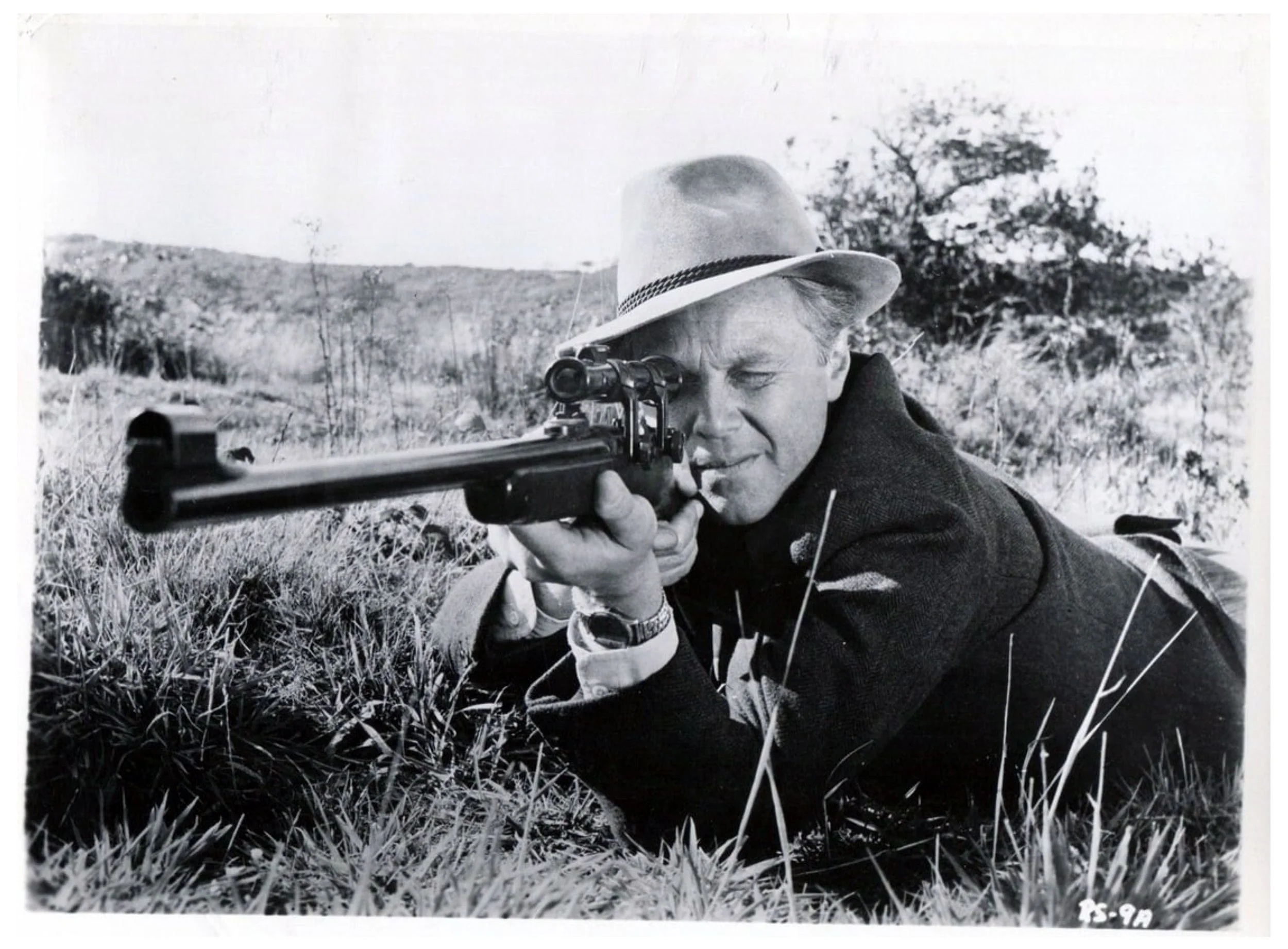
Marius Goring in Rough Shoot, 1953, scripted by Eric Ambler
So did Ambler predict the use of the sniper rifle in political assassinations in his hotel room in France in the early 1930s?
Perhaps he did. But even if not, and he had fantasised about killing the barman some other way, anecdotes like this don’t need to be perfectly logical to resonate. We smile at Ambler’s remark that if only the assassin had taken his room he might have got away, but a moment’s reflection reveals its flimsiness. In his 1951 novel Judgement on Deltchev, a character addresses this exact problem:
‘You know, when there is a parade great care is taken to guard against assassins. The occupants of rooms overlooking the Square are carefully checked by the police and the flat roofs of the buildings round it are guarded by troops from outside the city.’
We know this, but I think we still want Ambler’s wry remark to be true: if only the King of Yugoslavia’s assassin had been where Ambler was!
But this wasn’t what was bothering me. What was nagging at me was the anecdote’s narrative perspective.
Ambler’s novels are packed to the brim with assassinations and assassination attempts. The Dark Frontier features two successful ones: Rovidsky is shot through the forehead on the train in Chapter 6, and Andrassin is dragged from his house and beaten to death in Chapter 11. In Journey Into Fear, Graham is being hunted by a ‘professional gunman’ from Romania, Petre Banat:
‘Soon after he came out of prison he joined Codreanu’s Iron Guard. In 1933 he was charged with the assassination of a police official at Bucova. It appears that he walked into the official’s house on Sunday afternoon, shot the man dead, wounded his wife, and then calmly walked out again. He is a careful man, but he knew that he was safe. The trial was a farce. The courtroom was filled with Iron Guards with pistols, who threatened to shoot the judge and everyone connected with the trial if Banat were convicted. He was acquitted.’
In The Mask of Dimitrios, Dimitrios is said to have been involved in several assassinations, including supplying a Croat with a pistol in Rome and being involved in the 1923 killing of Bulgarian prime minister Aleksandar Stamboliyski. The theme continued throughout his career. His 1974 novel Doctor Frigo perhaps bears the most similarity to the Marseilles anecdote, with a political assassination carried out using an M16:
‘“They have not recovered the actual rifle, but it was certainly fired from the roof parapet of the office building opposite, a distance of about a hundred and thirty-five metres. The parapet was rendered accessible from outside the building by a temporary ladder leading to floodlight supports. The television people had not had time to dismantle them yesterday. As to the perpetrator of this outrage, the police have reports from eight eye witnesses. All say that immediately prior to the shooting they saw a priest in a white soutane on the parapet. He was holding some object which none saw properly. One of the witnesses thought it was a motion picture camera of some sort. Obviously he was mistaken.”’
All these can readily be seen as the result of Ambler becoming inspired by his imagination’s coincidental collision with reality in Marseilles. Assassination became a new topic to explore, and a key element in his fiction: pistols are bought by ruthless men from far-flung parts of Europe, politicians are gunned down at parades.
All the assassins in Ambler’s novels are very nasty pieces of work, and his protagonists usually fear being killed by them. But in Ambler’s anecdote, just as he identified with the real Croatian assassin, we identify with him: the cheating barman is the villain of the story. In Ambler’s novels, we never see the action from the perspective of a would-be assassin. That could be a story to read, and seems to be the promise of the Marseilles anecdote, but Ambler never wrote it.
Except it turns out that he did. He never acknowledged it, and it’s never been mentioned anywhere before, but Ambler wrote a short story inspired by the incident in Marseilles and it was published in 1933, three years before The Dark Frontier. That’s also the year before the assassination of the King of Yugoslavia.
Ambler wrote it under a pseudonym, and it was one of at least 16 short stories he published using this name. Taken as a whole, they give us a fresh perspective on Ambler’s development as a writer. But this one story in particular is the missing link between the incident in Marseilles and his novels: the story of an assassination in France, told from the assassin’s perspective.
NOTES
1. ‘“At 19, an agent advised him to forget about writing”’ by Terry Coleman, The Guardian, 2 February 1970.
2. ‘Ambler at 80’, presented by Michael Barber, Radio 4, 30 June 1989. Available in Eric Ambler: A BBC Radio Collection, July 2019 : https://www.penguin.com.au/books/eric-ambler-9781787537095 You can listen to the interview on Spotify and elsewhere.
3. ‘With a Flair for Creating Alarm’ (a review of The Schirmer Inheritance) by C. Day Lewis, New York Times, 26 July 1953. Available at: https://www.nytimes.com/1953/07/26/archives/with-a-flair-for-creating-alarm-the-schirmer-inheritance-by-eric.html